

Business of Sport
Leonard Curtis shines fresh light on Prem Rugby club finances in new report
- Harlequins retain top spot in Rugby Financial Performance Index, narrowly ahead of Leicester Tigers who went above Northampton Saints into second place.
- Despite some encouraging signs of growth in matchday and commercial income, in 2023/24 Prem Rugby clubs made a combined loss of £34m, with no team making a profit for a third successive year.
- Total debt reached £342.5m across the league, while six of the clubs were still balance sheet insolvent, compared with seven in 2022/23.
- New analysis of clubs’ accounts from 2014/15 to 2023/24 shows cumulative losses amount to £176.9m over ten years.
- Report also assesses a possible franchise model for Prem Rugby and concludes clubs could save between £1.1m and £1.9m from shared services, combined with centralised governance, but warns a wage to revenue ratio limit of 70% may be needed initially.
- James Haskell, who wrote the report’s foreword, says: “A franchise system could reset Prem Rugby. It would mean starting again, reassessing every club’s business model.”
The outlook for English professional rugby has come under fresh scrutiny with the publication of the second edition of the Leonard Curtis Rugby Finance Report, which features a breakdown of all Prem Rugby clubs’ financial results from 2014/15 to 2023/24.
The findings show that despite encouraging signs of growth in matchday and commercial revenues at several clubs, no Prem Rugby team made a profit for a third successive year, with the ten teams making a combined loss of £34m in 2023/24.
Over the ten-year period assessed in the report, the cumulative losses of Prem Rugby clubs now stand at £176.9m.
In 2023/24, clubs lost £3.4m on average, equivalent to around £283,000 per month and roughly £71,000 per week.
The figures also reveal that total debt in 2023/24 for the ten current clubs amounted to £342.5m, up from £329.8m in 2022/23 for the same set of clubs.
For 2023/24, six clubs were balance sheet insolvent, meaning they were reliant on financial support from their owners, as they were also loss-making. That compares with seven clubs for 2022/23, although the change came from Saracens’ capitalisation of loans due to the club’s parent company.
The report was launched on November 12th, 2025, at an event held at London’s Honourable Artillery Company, a location with a rich history as a rugby union venue, going back to the founding of HAC Rugby Club in 1896.
Harlequins retain top spot in Financial Performance Index
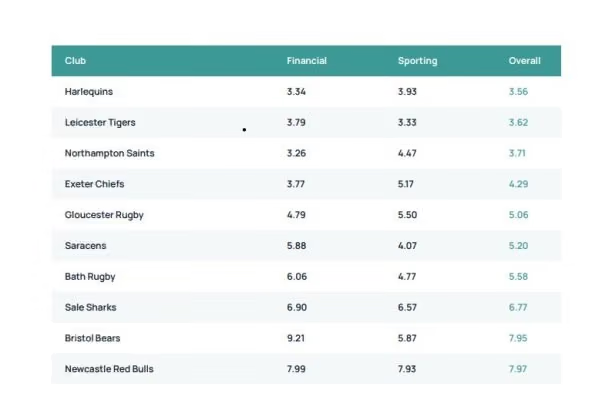
The latest report features an updated Rugby Financial Performance Index, ranking Prem Rugby clubs based on their financial and sporting performance from 2014/15 to 2023/24.
With a lower overall score in the Index more desirable, Harlequins (3.56) narrowly pip Leicester Tigers (3.62) and Northampton Saints (3.71) to retain top spot.
Newcastle – taken over by Red Bull in August 2025 – are bottom of the table, with scores of just under 8 in both areas of performance and an overall score of 7.97.
Rugby Financial Performance Index: The rankings from 2014/15 to 2023/24
Franchise model assessment
The Leonard Curtis Rugby Finance Report 2025 comes amid growing speculation that Prem Rugby will adopt a franchise model as it looks to attract fresh investment and boost the league’s financial sustainability.
In its latest edition, Leonard Curtis has drawn upon its 30 years of restructuring expertise to examine how the league could be structured under such a system and what financial benefits it might bring.
The analysis concludes that through a franchise licensing system clubs could save between £1.1m to £1.9m annually on a typical £20m turnover from shared services, combined with centralised governance.
However, Leonard Curtis warns that club finances would only be stabilised under a franchise structure if the model was combined with:
- Independent financial regulation.
- Disciplined cost controls – with the existing £6.4m salary cap paired with a recommended wage to revenue ratio limit of 70% initially.
- Transparent annual licensing/grading.
- Solidarity with a properly supported second tier.
James Haskell backs proposed franchise model
The proposed franchise structure outlined by Leonard Curtis has been backed by James Haskell, who has written the report’s foreword for a second year.
“A franchise system could reset Prem Rugby,” Haskell said. “It would mean starting again, reassessing every club’s business model, encouraging the next generation of domestic players, and rebuilding around a sustainable core.
“Add in proper wage to revenue guardrails and the appointment of an independent regulator, and we might finally have the beginnings of something that looks like a sustainable business model.”
He warned that without radical change “the game will fragment even further, and the very structures meant to preserve rugby may well be the ones that destroy it.”
“The current model is proven. It is a loss-making one.”
Speaking at the launch event, Alex Cadwallader – a Leonard Curtis director and former England U21 player – said: “There are no surprises in our latest report. Not in the most recent figures. Not in the figures for the last ten years. The current model is proven. It is a loss-making one.
“The clubs collectively have been loss-making every year in the last ten years once the exceptional items such as ground sales in 2014/15 and the CVC investment deal in 2018/19 are removed. The amount of debt continues to grow.
“Yes, there are sprouts of growth and recovery in some metrics, but a large leap needs to be taken to reverse the current trend that is firmly bedded in. The game is reliant on benefactors funding their clubs for which we are grateful. However, this cannot continue.
“The competition in France is moving forward and disruptors with new models are circling. The question really should be why would we not consider a different model.”
Potential route towards sustainability
Phil Lyons – a director and performance advisory lead at Leonard Curtis, who assessed the potential benefits of a franchise model for the report – commented: “This report shows that although progress is being made, it is not yet of the order to make significant inroads into the continued losses experienced in English rugby’s top tier.
“We outline a potential route towards sustainability in the form of a franchise league model, assessing its potential merits from a financial perspective in an effort to add to the sporting discussion that has already begun.”
“A decade of structural financial fragility”
Reflecting on the report’s key findings, co-author Prof Rob Wilson, who is a professor of applied sport finance, commented: “English professional rugby has now had a decade of structural financial fragility, and our report shows that this is still present systemically today.
“The priority now must be building durable recurring revenue; disciplined cost control linked to key central financial metrics and genuine alignment between sporting ambition and sustainable wage spend. That is what real long-run financial health looks like.”
He added: “The franchise debate is ultimately a financial sustainability debate. Fragmented incentives and volatility have cost the game enormously, both competitively and reputationally.
“If the sport wants to attract serious capital back in at scale, whether through institutional capital, private capital or new strategic partners, it must demonstrate a credible long-run route to stable cashflow and return on investment.
“Whatever the governance model ultimately becomes, the market will reward clubs and the league for predictability in revenues (not match results – they must remain unpredictable), transparency, cost discipline and high-quality revenue growth.
“If English rugby can execute those fundamentals, this sport can genuinely move itself into a position where growth is funded by profit, not benefactors.”
Red Roses’ World Cup victory gives PWR platform for growth
Turning its attention to the women’s game, the Leonard Curtis Rugby Finance Report 2025 also examines the potential impact on Premiership Women’s Rugby (PWR) of the Red Roses’ victory on home soil in this year’s Women’s Rugby World Cup.
Gessica Howarth, vice-president and a founding member of Sphera Partners, a growth equity investment firm focused on women’s sport, is on the expert panel which contributed to the report.
“The 2025 Women's Rugby World Cup victory has given domestic women’s rugby an unprecedented platform – one built on record-breaking attendances, mass viewership, and genuine national pride, showing that demand for women’s rugby is real, broad, and here to stay,” she said.
“But to convert this surge in visibility into lasting impact, we must turn reach into depth: transforming one-off moments into week-to-week loyalty, ensuring players remain at the heart of the game’s growth, and building a sustainable, commercially viable model.”
Women’s game faces concerns over low competitive balance
A key challenge facing the women’s game is low competitive balance, and new research presented in the Leonard Curtis Rugby Finance Report 2025 highlights the difference in unpredictability between Prem Rugby and the PWR, as measured by HICB, an academic metric used to establish long-run competitive balance values within leagues over time. The closer the value is to 100, the more balanced a league is in any given season.
The data shows that in the eight seasons since the PWR was established in 2017/18, while the average HICB score for Prem Rugby was 108.93, for PWR it was 127.86.
Dr Ellie Nesbitt, a senior lecturer in sport management at Nottingham Trent University, who carried out the research, said: “While competitive balance in the men’s Premiership remains strong, the significantly lower competitive balance in the PWR is a cause for concern.
“It risks fan disengagement due to the predictability of the games and results. Closing the gap between elite and emerging teams is therefore essential for the league’s long-term growth and success.”
The Leonard Curtis Rugby Finance Report 2025 is the third in a series of reports from Leonard Curtis on the Business of Sport, find out more and download the report.
Feedback Form
Lorem ipsum dolor sit amet, consectetur adipiscing elit. Donec ultricies consequat.
News and insights

Get in touch
with Leonard Curtis
Forward
with purpose


Leonard Curtis is a trading style of Reach Commercial Finance Limited, registered at Leonard Curtis House, Elms Square, Bury New Road, Whitefield, M45 7TA. Company Register number is 09056450. Reach Commercial Finance Limited is authorised and regulated by the Financial Conduct Authority, FRN: 753686. Reach Commercial Finance Limited is an authorised credit broker and not a lender. We work with an unrestricted number of lenders to find a potentially suitable arrangement for your consideration. ICO registration ZA069234 and you can check via www.ico.org.uk. We will receive commission from lenders. Different lenders pay different amounts depending on different commission models. For transparency we work with the following commission models: fixed fee, fixed rate of commission, percentage of the amount you borrow and rate for risk (this is based on the risk profile of the business). Further details of the commission model, calculation and amount will be disclosed to you throughout your customer journey. Privacy notice.
Leonard Curtis Legal Limited is a limited company, registered in England and Wales with registered number 09820186. Registered office: Leonard Curtis House, Elms Square, Bury New Road, Whitefield, M45 7TA. Leonard Curtis Legal Limited is registered with the Solicitors Regulation Authority with number 626004.