

Business of Sport
New Leonard Curtis report exposes deep-rooted challenges for Prem Rugby clubs as league moves to franchise-style model
Leonard Curtis has released the third edition of its annual Rugby Finance Report, delivering a fresh assessment of the state of English club rugby following the move to a franchise-style model for Prem Rugby and new investment coming into the game over the past year.
The latest report features a comprehensive overview of the finances at all ten current Prem Rugby clubs, together with analysis of the league’s introduction of a new £5.4m salary floor and an assessment of Red Bull’s takeover of Newcastle.
Also included is a new Digital Footprint Index for Prem Rugby clubs examining the social media and wider digital presence of each team and how it could boost commercial revenues.
In addition, the report takes a look at the evolution of Premiership Women’s Rugby (PWR), examines the latest competitive balance trends in both the men’s and women’s game, and includes a focus on sports kit circular ecosystem kitround and its partnership with the London Irish Foundation.
The report was launched at an event on 3rd November at The Berkeley hotel in London attended by over 50 guests, including sports industry executives, finance and business leaders, and media.
Wage bills, losses and debts all rise in 2024/25
The Leonard Curtis Rugby Finance Report 2026 concludes that while the move to a franchise-style structure for Prem Rugby and new investment are positive steps forward for the league, the game continues to face deep-rooted challenges which any new investor will need to grapple with.
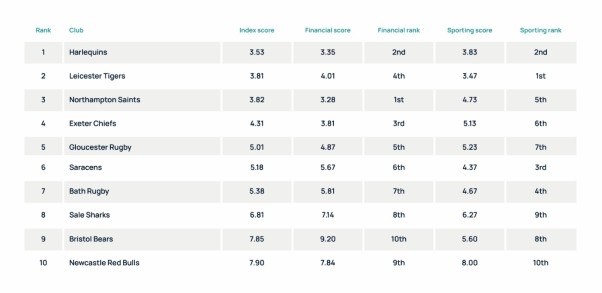
Those difficulties are underlined by the updated ten-year Financial Performance Index included in the report, covering the period from 2015/16 up to 2024/25, the most recent financial year where data is publicly available.
The figures show that combined revenues for Prem Rugby clubs fell to £178.9m in 2024/25, down from £182.2m the previous year, while the total amount spent on wage bills, covering all staff costs, rose to £129.8m, up from £125.9m in 2023/24.
The average wage to revenue ratio across the ten clubs increased to 80% for 2024/25, compared with 75% the previous season, marking the third year in a row the ratio has risen.
Total losses across the league climbed to £36.5m in 2024/25, up from £34m in 2023/24, again a third successive annual increase. The latest cumulative figure represents an average loss per club of £3.7m, equivalent to around £308,000 per month and roughly £77,000 per week.
Combined debt levels also continued to rise, reaching £366.1m in 2024/25, an increase from £342.5m in 2023/24, while for a second successive year the same set of six Prem Rugby clubs could be classed as balance sheet insolvent in 2024/25.
“Significant challenges remain within the game”
Alex Cadwallader, a Leonard Curtis director and former England U21 rugby union player, said: “The findings in our latest report should not come as a surprise to anyone who has shown an interest in the financial state of the professional club game in England.
“The figures show Prem Rugby sides have continued to make a combined loss of over £30m each year and highlight the significant challenges that remain within the game. Without any deep structural or governance changes, why would we expect the results to be any different?”
Cadwallader – who played for Newcastle, Bristol, Newport and London Welsh over a 10-year career – welcomed Prem Rugby’s switch to a franchise-style model, but stressed the game must tackle underlying issues such as cost control for the move to deliver financial stability.
In the 2025 edition of the Leonard Curtis Rugby Finance Report, the firm drew upon its 30 years of restructuring expertise to examine how the English top-flight could be structured under a new model and what financial benefits it might bring.
The analysis concluded that through a franchise licensing system clubs could save between £1.1m to £1.9m annually on a typical £20m turnover from shared services, combined with centralised governance.
“In our report last year, we mapped out how a franchise structure might have a positive impact for Prem Rugby and I’m pleased to see they are going in this direction and appear to have followed some of our suggestions,” Cadwallader said.
“The move to a different model has undoubtedly assisted in attracting more investors to the game, as many will favour a closed league, which for them translates into guaranteed revenues.”
Key tests for Prem Rugby lie ahead
Prof Rob Wilson, co-author of the Leonard Curtis Rugby Finance Report, and Provost at UCFB, commented: “The move towards a franchise-style model is an encouraging development for English rugby, and provides a welcome step for beginning to solve the game’s financial challenges.
“Our analysis continues to show a sport where ambition consistently outpaces commercial performance, with rising wage bills, mounting debt and an enduring reliance on owner investment.
“New capital is encouraging, but access to investment should not be confused with financial sustainability. The real test is whether clubs can convert that investment into stronger revenues, wider audiences and viable long-term business models.
“Without that shift, we risk simply financing the same problems under a different structure.”
Rugby Financial PerformanceIndex: The rankings for 2015/16 to 2024/25
“Closed league givesinvestors something rugby has never offered before”
Former Scotland and Bath rugby player Simon Danielli, now head of investor relations & operations at private equity firm Agathos, is an expert contributor to the Leonard Curtis Rugby Finance Report and discussed its key findings at the launch event.
"Leonard Curtis deserves real credit for once again shining a light on the state of English club rugby, and the report doesn't shy away from the hard truths – £36.5m of combined losses and over £366m of debt make for stark reading,” he said.
“But there are green shoots. A closed league gives investorssomething rugby has never offered before: visibility of revenue and security ofearnings. That is why serious capital is arriving, from Red Bull at Newcastleto new US investment at Exeter.
“Investors back what they believe can grow. The challenge now, for everyone in the game, is turning that confidence into a clear path to sustainable profitability."
Contrasting shifts in competitive balance for Prem Rugby and PWR
The analysis of competitive balance in the Leonard Curtis Rugby Finance Report 2026 reveals contrasting developments for Prem Rugby and Premiership Women’s Rugby(PWR).
The assessment shows that over the past three seasons the overall competitive balance of Prem Rugby – in terms of the distribution of points across the league – has weakened, with the gap in performance between clubs widening.
Despite a run of six different winners of the Prem Rugby title in six successive seasons between 2019/20 and 2024/25, the 2025/26 competition recorded the greatest imbalance between teams since 2013/14.
For the PWR, the report found that while it remains less competitively balanced than the men’s top-flight it has shown a sustained improvement, with the 2025/26 season proving the most competitive since the league’s inception in 2017/18, indicating the league as a whole is becoming more evenly matched.
Dr Ellie Nesbitt, a senior lecturer in sport management at Nottingham Trent University, who conducted the analysis, said: “The assumption is often that a league is healthy if different teams keep winning titles. What our analysis shows is that the picture can be much more complicated.
“In Prem Rugby, the 2025/26 season produced the weakest competitive balance score for more than a decade, suggesting the gap between the leading clubs and those at the bottom of the table has widened, regardless of the variety of champions in recent years.”
She added: “In contrast, PWR recorded its most competitively balanced season since the league’s launch in 2017/18. However, that headline figure should also be treated with some caution. While overall competitive balance is improving, Leicester Tigers were unable to record a single league victory during the 2025/26 season, highlighting the disparities that still exist between clubs.”
kitround partnership with London Irish Foundation
In addition, this year’s Leonard Curtis Rugby Finance Report profiles kitround, a data-driven circular ecosystem designed to cut waste, support pre-gamed affordable kit redistribution, stimulate participation and keep kit out of landfill.
A recent partnership with the London Irish Foundation has resulted in over 2,400 kg CO2e avoided, and more than 200 kg of kit diverted from landfill, while also raising £10,000 for youth initiatives.
kitround CEO and co-founder Wendy Carter said: “We have made some remarkable progress in a short time by onboarding like-minded people and aligning agendas with our own.
“By creating a unified data-driven platform we have made it easy for partners like the London Irish Foundation to engage and help everyone address the environmental and social challenges of sports kit waste.”
London Irish Foundation CEO Andy Keast added: “This partnership is about more than just sports; it’s about creating access, building confidence, and giving young people the tools they need to grow both on and off the field.”
Connecting Prem Rugby and UK business
The Leonard Curtis Rugby Finance Report 2026 also contains a message from Leonard Curtis CEO Dan Booth, who leads the private equity-backed corporate restructure firm, which helps business owners and their advisers navigate complex, challenging situations every day.
“By connecting the ambition and reach of Prem Rugby with the experience, expertise and entrepreneurial spirit of UK business, we can create partnerships that deliver mutual benefit, stimulate fresh thinking and support sustainable growth,” he commented.
“Ultimately, rugby and business share a belief that the best results come when people work together towards a common goal. By aligning on that shared purpose, we can build stronger relationships and have more durable success.”
Feedback Form
Lorem ipsum dolor sit amet, consectetur adipiscing elit. Donec ultricies consequat.
News and insights

Get in touch
with Leonard Curtis
Forward
with purpose


Leonard Curtis is a trading style of Reach Commercial Finance Limited, registered at Leonard Curtis House, Elms Square, Bury New Road, Whitefield, M45 7TA. Company Register number is 09056450. Reach Commercial Finance Limited is authorised and regulated by the Financial Conduct Authority, FRN: 753686. Reach Commercial Finance Limited is an authorised credit broker and not a lender. We work with an unrestricted number of lenders to find a potentially suitable arrangement for your consideration. ICO registration ZA069234 and you can check via www.ico.org.uk. We will receive commission from lenders. Different lenders pay different amounts depending on different commission models. For transparency we work with the following commission models: fixed fee, fixed rate of commission, percentage of the amount you borrow and rate for risk (this is based on the risk profile of the business). Further details of the commission model, calculation and amount will be disclosed to you throughout your customer journey. Privacy notice.
Leonard Curtis Legal Limited is a limited company, registered in England and Wales with registered number 09820186. Registered office: Leonard Curtis House, Elms Square, Bury New Road, Whitefield, M45 7TA. Leonard Curtis Legal Limited is registered with the Solicitors Regulation Authority with number 626004.