

Group News
HMRC Annual Report 25/26: Tax Debt Holds at £43.8bn
HMRC recently published its annual report for the year to 31 March 2026, and it paints a picture of tax debt that has settled into a persistent, structural problem rather than a lingering pandemic hangover.
Total debt balance
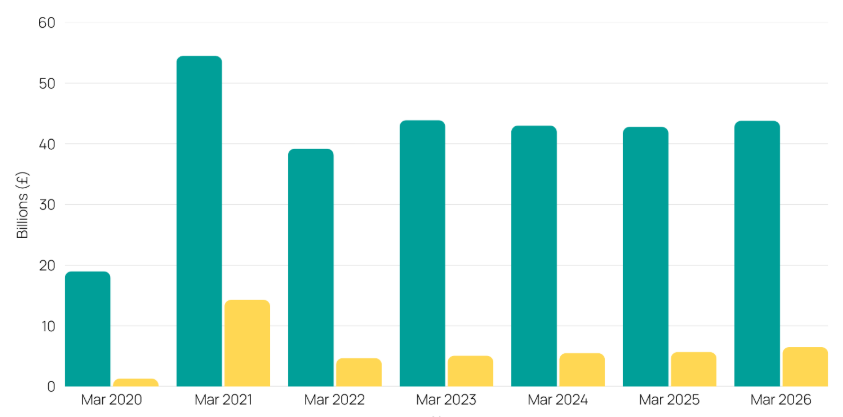
Tax debt stood at £43.8 billion on 31 March 2026. That's roughly three times the pre-pandemic norm. Before COVID, the balance typically sat between £15–20 billion. What stands out this year isn't the size of the number so much as its stability: debt has now held at broadly this level for four consecutive years, suggesting HMRC has stopped the post-pandemic bleeding but hasn't found a way to meaningfully bring the balance back down.

Debt is getting older
Perhaps the more concerning trend sits underneath the headline number: the debt that remains is ageing. 45% of the balance is now more than 12 months old, and 23% is more than three years old, which makes it more difficult to collect. A static total combined with a rising share of old debt implies that HMRC is managing to work through newer, easier-to-collect debt while a hard core of older debt sits largely untouched.
Time to Pay
£6.5 billion of the total is currently held within agreed Time to Pay (TTP) arrangements, up from £5.7 billion the year before - an increase of around 14%. HMRC continues to treat the level of debt held within TTP as one of its key indicators of debt management performance. The direction of travel here is a genuinely positive one: it suggests more of the "difficult but willing to pay" cohort are being brought into structured arrangements rather than drifting into further arrears.
The bigger picture
Put together, the numbers suggest HMRC has broadly stabilised the scale of tax debt after the pandemic shock but has not yet found the mechanism to bring it down meaningfully.
For business owners and advisers with clients navigating HMRC debt, the read-through is straightforward: HMRC is willing to negotiate, and the growth in TTP arrangements/the TTP balance shows that willingness.
Next steps
Going to HMRC directly is a perfectly viable route, and many businesses do exactly that. The difficulty arises in how the case is put together: a proposal that doesn't clearly evidence how the arrears built up, what the business can realistically afford, and why the proposed schedule is sustainable is far more likely to be turned down or accepted on terms too tight to actually stick to.
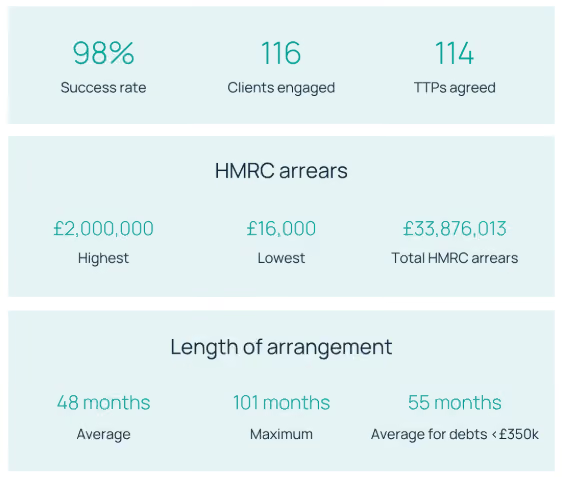
This is where specialist support makes a real difference. Our Business Advisory team knows how to build a case HMRC will accept, and it shows: they secured 114 Time to Pay arrangements in the first half of 2026 alone with a value of over £33 million.
We champion proactive debt management because the earlier a business seeks support, the more options remain available. Early engagement gives our specialists the best chance of negotiating affordable repayment terms with HMRC, safeguarding businesses from unnecessary strain and keeping more doors open.
Get in touch
If arrears are building, the earlier that conversation happens, the more options are still on the table. Contact the team on 0161 835 1900 or via hello@leonardcurtis.co.uk.
Source: HMRC Annual Report & Accounts 2025-26; National Audit Office analysis of HMRC data.
Feedback Form
Lorem ipsum dolor sit amet, consectetur adipiscing elit. Donec ultricies consequat.
News and insights

Get in touch
with Leonard Curtis
Forward
with purpose


Leonard Curtis is a trading style of Reach Commercial Finance Limited, registered at Leonard Curtis House, Elms Square, Bury New Road, Whitefield, M45 7TA. Company Register number is 09056450. Reach Commercial Finance Limited is authorised and regulated by the Financial Conduct Authority, FRN: 753686. Reach Commercial Finance Limited is an authorised credit broker and not a lender. We work with an unrestricted number of lenders to find a potentially suitable arrangement for your consideration. ICO registration ZA069234 and you can check via www.ico.org.uk. We will receive commission from lenders. Different lenders pay different amounts depending on different commission models. For transparency we work with the following commission models: fixed fee, fixed rate of commission, percentage of the amount you borrow and rate for risk (this is based on the risk profile of the business). Further details of the commission model, calculation and amount will be disclosed to you throughout your customer journey. Privacy notice.
Leonard Curtis Legal Limited is a limited company, registered in England and Wales with registered number 09820186. Registered office: Leonard Curtis House, Elms Square, Bury New Road, Whitefield, M45 7TA. Leonard Curtis Legal Limited is registered with the Solicitors Regulation Authority with number 626004.